For households facing higher prices and mortgage costs, the political argument needs specifics. Which pressures can government influence, and how soon could its policies help?
Treasurer Jim Chalmers's response to the September rate rise placed heavy emphasis on the Middle East conflict and its economic consequences. His 29 September statement also defended the government's cost-of-living measures and budget management. Those are the government's arguments, not an independent assessment of its record. [1]
In a statement following the 30 September inflation release, Chalmers attributed the rise in annual headline inflation to higher fuel costs and the unwinding of earlier energy rebates. He also acknowledged an existing domestic inflation challenge. [2]
A monthly result and a longer-running problem
A movement in fuel prices or a rebate ending can change the annual inflation comparison. Explaining that movement is different from explaining why price pressure persists across the economy.
The RBA's September explanation was broader. Bullock said domestic capacity pressures were driving inflation, with the conflict adding to them. [3] It is possible for that diagnosis and the Treasurer's explanation of a particular month's increase both to contain relevant information. They answer different questions.
The ABS reports annual headline inflation of 4.0% and annual trimmed mean inflation of 3.6%. Read these alongside their components, reporting periods and other economic evidence. [4]
What the opposition is arguing
ABC reporting on 30 September records Opposition Leader Angus Taylor's criticism of government spending and economic management. The same report records Chalmers's defence and the RBA's refusal to assign the problem to a single political culprit. [5]
The opposition's case should be assessed as a policy argument: which spending would change, by how much, at what time, and with what effect on services and demand? The government's case deserves equally specific questions. Announcing relief is not the same as demonstrating that a measure improves affordability without adding unwanted pressure elsewhere.
Keep the measured outcomes separate from explanations and policy proposals. A claim about a policy's effect needs evidence of how it works and over what period.
Relief and inflation control are different tests
Imagine a fictional household receiving a temporary $200 bill credit. Its immediate cash position improves. But whether the broader inflation problem improves depends on more than that household's bill: how the measure is funded, who receives it, how it affects demand and whether underlying supply costs change.
This example is not an estimate of any current programme. It illustrates why a policy can help a household in the short term without permanently reducing the cost of supplying electricity. It also shows why the withdrawal of temporary relief can complicate annual price comparisons.
Our view is that cost-of-living policy needs to help households under pressure now while improving the conditions for sustainable prices and incomes. State each measure's purpose and trade-offs so those tests can be assessed.
What a useful political answer would contain
For immediate relief, ask who qualifies, when the help arrives and whether it reaches people with the least capacity to absorb another increase. For supply measures, ask what extra capacity will actually become available and when. For spending restraint, ask what will be reduced and who bears the cost.
For productivity claims, ask what practical change lets people produce more useful output with the same resources. A label on a budget package is not evidence that those gains have already arrived.
Higher borrowing costs can also discourage some investment, so the balance between restraining demand and expanding supply deserves scrutiny. The RBA's account of monetary-policy transmission explains why rate changes affect activity through several channels, rather than operating as a direct price-control switch. [6]
Ask what each side proposes to change and what improvement it expects. Government cannot set world oil prices, but its choices on relief, spending and supply can still be scrutinised.
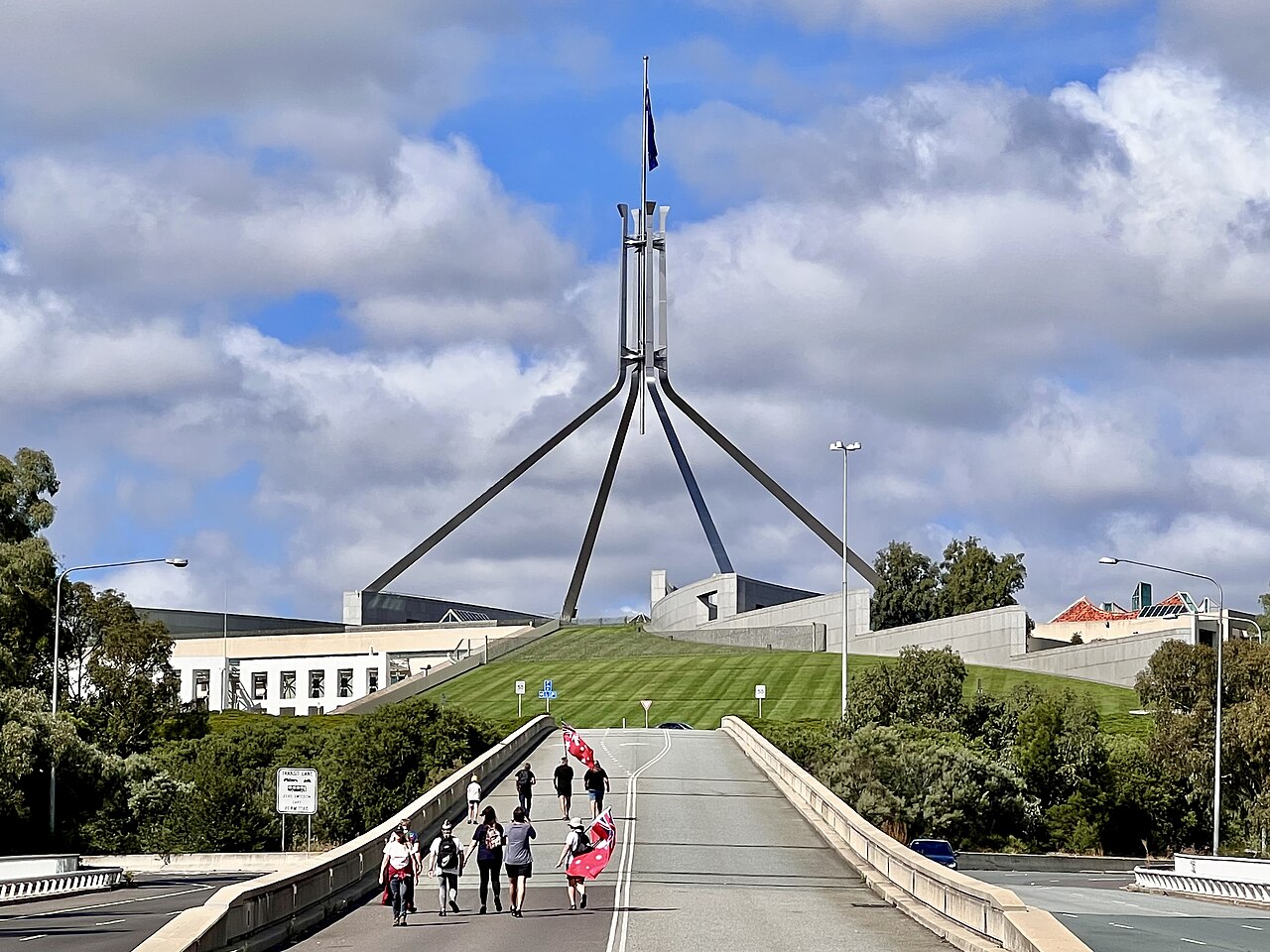
Image: Parliament House, Canberra, photographed in 2022. File image illustrating the setting of federal politics. Credit: Kgbo. Wikimedia Commons original. CC BY-SA 4.0. No image edits.

About the author
RullikClear, sourced explainers on Australia and the world
Rullik is the pen name of the founder of Australia Illuminate (Auslume). Rullik writes plain-language explainers on life in Australia, from immigration, study and work to money, sport and screen culture, always linking to the official sources behind each story. Every story is reviewed before publication.
More from Rullik ↗Sources
- https://ministers.treasury.gov.au/ministers/jim-chalmers-2022/media-releases/reserve-bank-interest-rates-decision-0
- https://ministers.treasury.gov.au/ministers/jim-chalmers-2022/media-releases/new-inflation-figures-6
- https://www.rba.gov.au/speeches/2026/mc-gov-2026-09-29.html
- https://www.abs.gov.au/statistics/economy/price-indexes-and-inflation/consumer-price-index-australia/latest-release
- https://www.abc.net.au/news/2026-09-30/labor-defends-spending-amid-high-inflation-rate-rise/107208962
- https://www.rba.gov.au/publications/bulletin/2017/sep/1.html