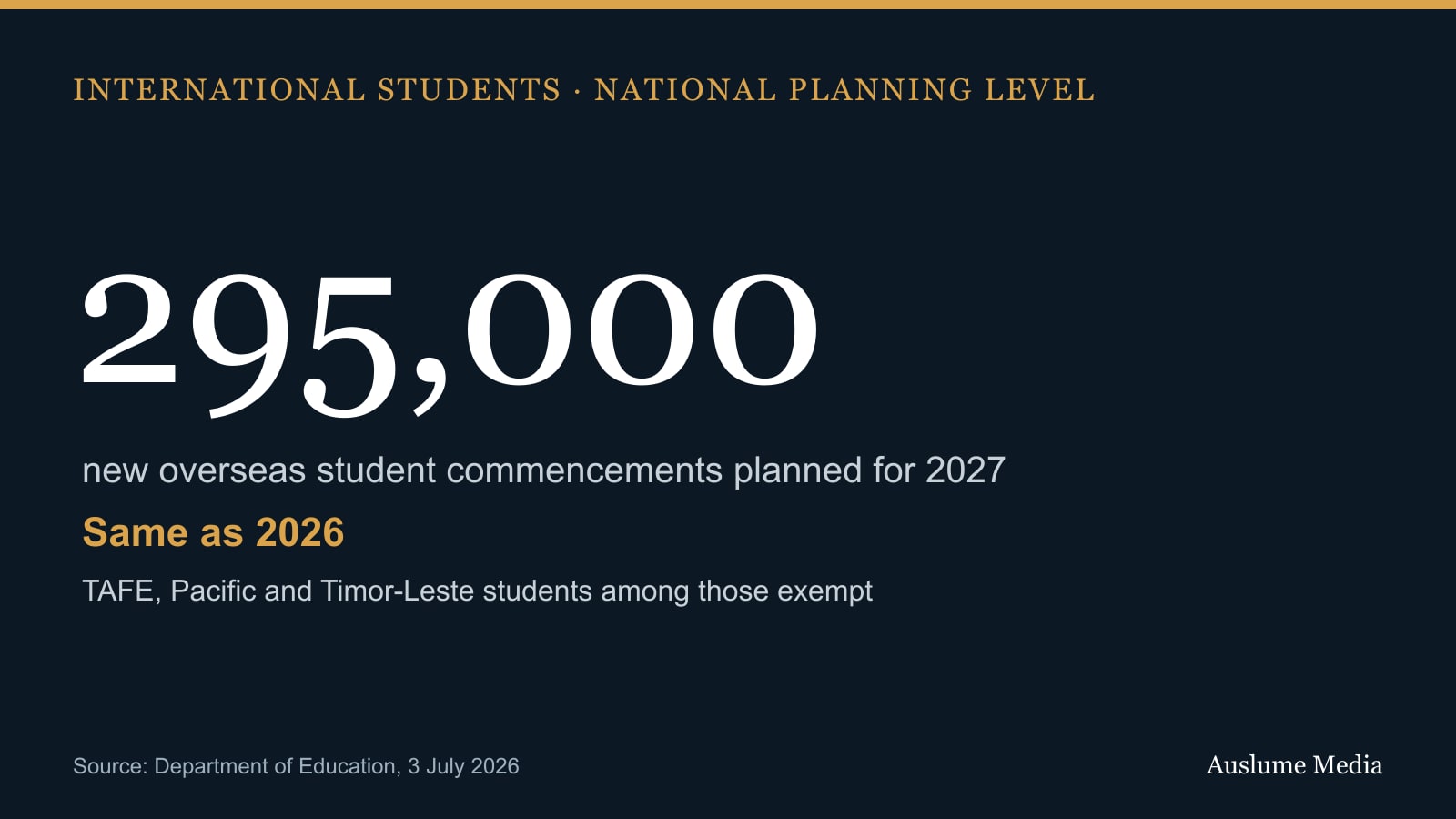
The number of new international students Australia plans for in 2027 will stay at 295,000, the same as this year. The Department of Education announced the 2027 National Planning Level on 3 July 2026, saying the aim is stability and continuity for the sector.
For students, the headline is simple: the door is not closing further. For providers, the detail matters more.
What the planning level actually counts
The National Planning Level, or NPL, counts New Overseas Student Commencements. According to Study Australia's guidance for agents, a student counts as a new commencement when they are onshore in Australia and start their first course that is not exempt, at their first provider. Changing into a non-exempt course at a different provider counts again.
It is not a hard cap on visas. Student visa applications are processed as high priority until a provider reaches its prioritisation threshold. In 2026 that threshold is 80 per cent of the provider's allocation. After that, applications are still accepted but processed more slowly.
No provider goes backwards
The Government has said no active provider will receive a lower allocation in 2027 than it did in 2026. Provider-level allocations for 2027 were due to be finalised in July 2026, so institutions should already know their numbers.
Who is not counted
A long list of students sits outside the planning level in 2027. They include:
students at TAFE, and in VET courses at dual-sector public universities
school students
students in standalone English language (ELICOS) courses
higher degree by research students
non-award and short-term exchange students
students on certain scholarships, including from foreign governments and Australian governments
students from the Pacific and Timor-Leste
students in pilot training courses
international students moving from secondary school in Australia into tertiary study
students moving from an affiliated pathway provider or TAFE into a publicly funded university
students who have to change provider because their provider closed or cannot continue.
Some transnational education arrangements approved by the Department of Education or the Department of Employment and Workplace Relations are also exempt.
What it means for students
If you are planning to study in Australia in 2027, a few things follow from these settings.
First, the Government's stated position is that any genuine student who meets the visa requirements can still apply and be granted a visa. The planning level changes how quickly applications are processed once a provider's allocation fills, not whether a genuine applicant can apply.
Second, timing can matter. Applying to a provider that still has room under its prioritisation threshold may mean faster processing than applying late in the year to one that is already full.
Third, the exemptions are worth checking. If you fall into one of the exempt groups, such as TAFE study or a Pacific or Timor-Leste student, you do not count against a provider's allocation.
The bigger picture
The Department of Education describes the current approach as a managed system for international education, with the planning level set each year. Keeping 2027 at the 2026 level gives providers and students a year of the same settings to plan around.
This article explains published Government settings. It is general information, not migration or education advice. Check with your provider and the Department of Home Affairs for your own visa application.

About the author
RullikClear, sourced explainers on Australia and the world
Rullik is the pen name of the founder of Australia Illuminate (Auslume). Rullik writes plain-language explainers on life in Australia, from immigration, study and work to money, sport and screen culture, always linking to the official sources behind each story. Every story is reviewed before publication.
More from Rullik ↗Sources
- https://www.education.gov.au/managed-system-international-education/announcements/national-planning-level-2027-announced
- https://www.studyaustralia.gov.au/en/Agent-Hub/agent-news-index/australian-government-confirms-2027-national-planning-level
- https://www.education.gov.au/managed-system-international-education