If you are on the minimum wage or an award rate, your pay should have gone up in early July. Almost three months on, it is worth checking that it did.
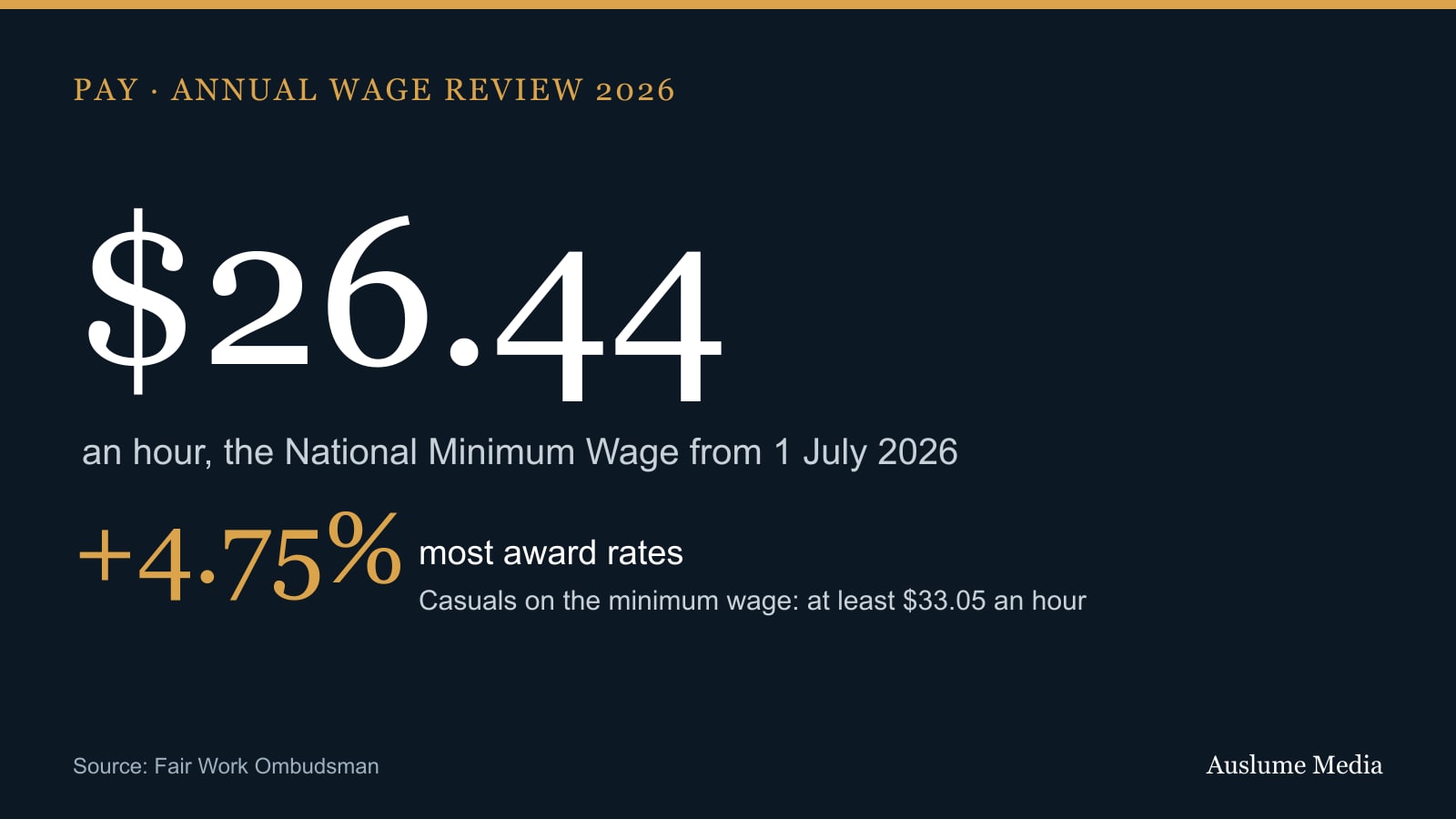
From 1 July 2026 the National Minimum Wage is $26.44 an hour, or $1,004.90 for a 38-hour week. Most award rates rose by 4.75 per cent. The Fair Work Ombudsman has updated its pay guides and its Pay and Conditions Tool with the new rates.
Who gets which increase
The National Minimum Wage applies to employees who are not covered by an award or an enterprise agreement. Most workers are covered by an award, and for them the 4.75 per cent increase to minimum award wages is the one that matters.
There are two floors inside the award system:
the lowest rate in any award for ongoing employment must be at least $1,004.90 a week, or $26.44 an hour
an entry-level rate for the first six months or less of a job must be at least $978.10 a week, or $25.74 an hour.
Casual employees on the National Minimum Wage must receive at least $33.05 an hour, which includes the 25 per cent casual loading, according to the Ombudsman's announcement.
When it starts
The increases apply from the first full pay period starting on or after 1 July 2026. That detail catches people out.
The Ombudsman gives an example. A hair salon pays weekly, Monday to Sunday. Because 1 July 2026 was a Wednesday, in the middle of a pay cycle, the new rates applied from the next cycle, starting Monday 6 July.
If your pay period started on or after 1 July, you should have been on the new rate from that pay period.
Enterprise agreements and trainees
If you are covered by an enterprise agreement, the increase may still reach you. The base pay rate in an agreement cannot be lower than the base rate in the relevant award, so if the award rate rose above your agreement rate, your employer has to pay at least the award rate.
Trainees under the National Training Wage get their increases on the same date as award wages.
Other changes that started on 1 July
The wage rise was not the only change. The Ombudsman lists several others that began at the same time:
Payday super. Employers now need to pay superannuation contributions at the same time as they pay wages.
Parental leave. Unpaid flexible parental leave increased to up to 130 days for a child born or adopted on or after 1 July 2026, and government-funded Parental Leave Pay rose to 130 days from 120.
Thresholds. The high income threshold rose to $190,100 and the unfair dismissal compensation cap to $95,050.
Two awards changed earlier. The Children's Services Award and the Pharmacy Award had separate increases from the first full pay period on or after 30 June 2026, followed by the general increase.
How to check your pay
Start with your payslip. It should show your hourly rate or salary, and the pay period dates. Then:
Find your award with the Ombudsman's Pay and Conditions Tool, or by checking the coverage clause of the award.
Compare your rate with the current pay guide for your award and classification.
If something looks wrong, raise it with your employer first, in writing if you can.
If that does not fix it, contact the Fair Work Ombudsman, which gives free advice and assistance on pay and workplace rights.
The Ombudsman is different from the Fair Work Commission. The Commission sets minimum wages through its annual review. The Ombudsman helps people understand and apply the rules.
This article is general information, not legal advice. For your own situation, use the Fair Work Ombudsman's tools or contact them directly.

About the author
RullikClear, sourced explainers on Australia and the world
Rullik is the pen name of the founder of Australia Illuminate (Auslume). Rullik writes plain-language explainers on life in Australia, from immigration, study and work to money, sport and screen culture, always linking to the official sources behind each story. Every story is reviewed before publication.
More from Rullik ↗