US Flight Shutdown Leaves Australian Travellers Stranded as Thousands of Flights Are Disrupted
15 November 2026 | AusLume Media
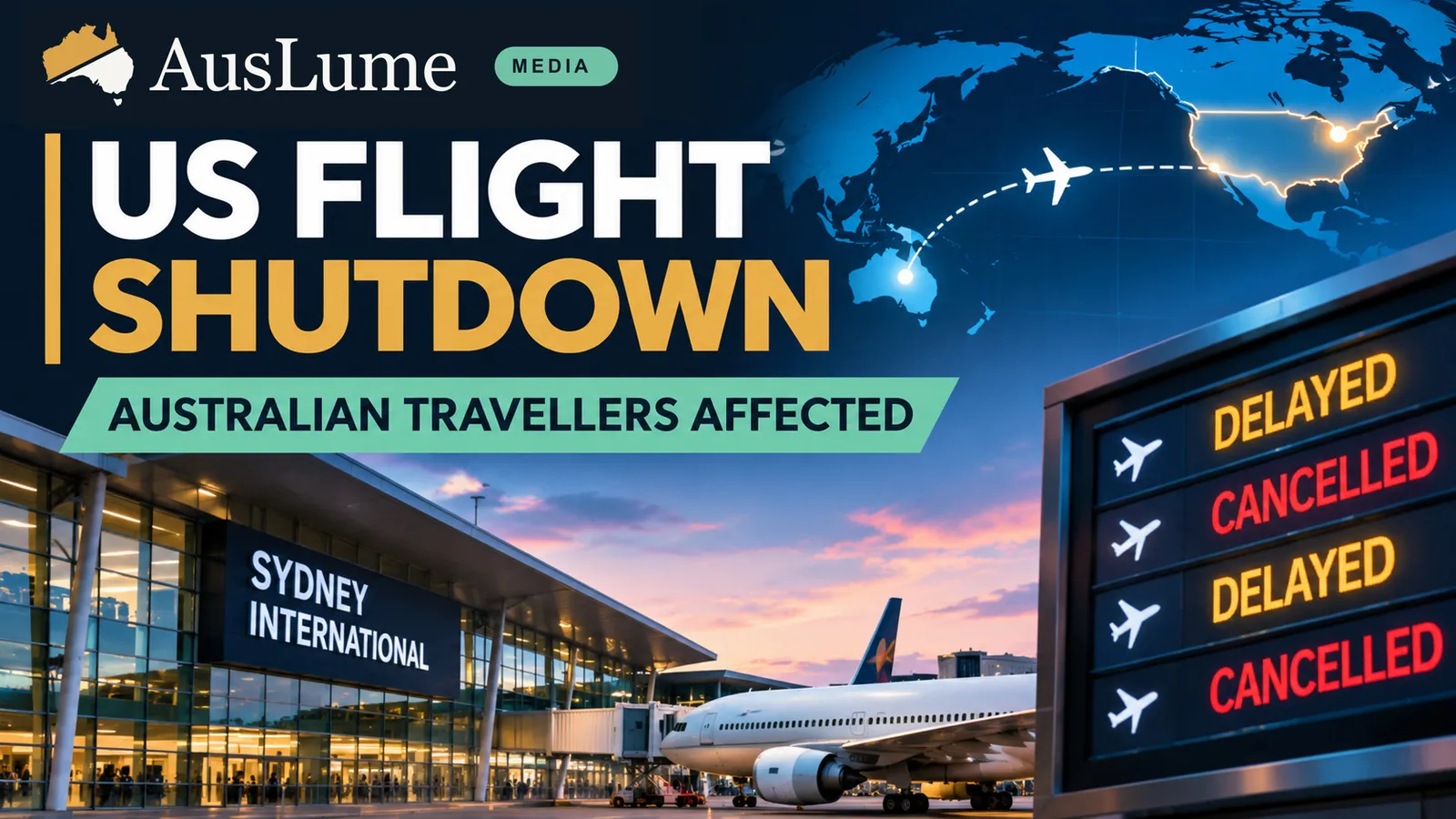
A major failure in the United States air traffic control system forced aviation authorities to temporarily stop departing flights nationwide on Friday, 13 November, local time.
The shutdown disrupted thousands of flights, left travellers stranded and affected US-bound services from Australian airports. Although the nationwide ground stop has been lifted, airlines are still working through the disruption, with passengers advised to monitor their bookings.
Key points
The US Federal Aviation Administration (FAA) temporarily stopped departing flights nationwide following communications and radar problems.
The ground stop lasted approximately five hours before authorities reopened US airspace.
Reuters reported more than 4,700 cancellations and around 10,000 delays on Friday.
Flights from Sydney, Melbourne and Brisbane were affected.
US officials said ageing communications equipment contributed to the failure.
Investigators had found no evidence of a cyberattack, although inquiries were continuing.
Australia's Smartraveller service has advised passengers to check directly with their airlines.
What caused the nationwide US flight shutdown?
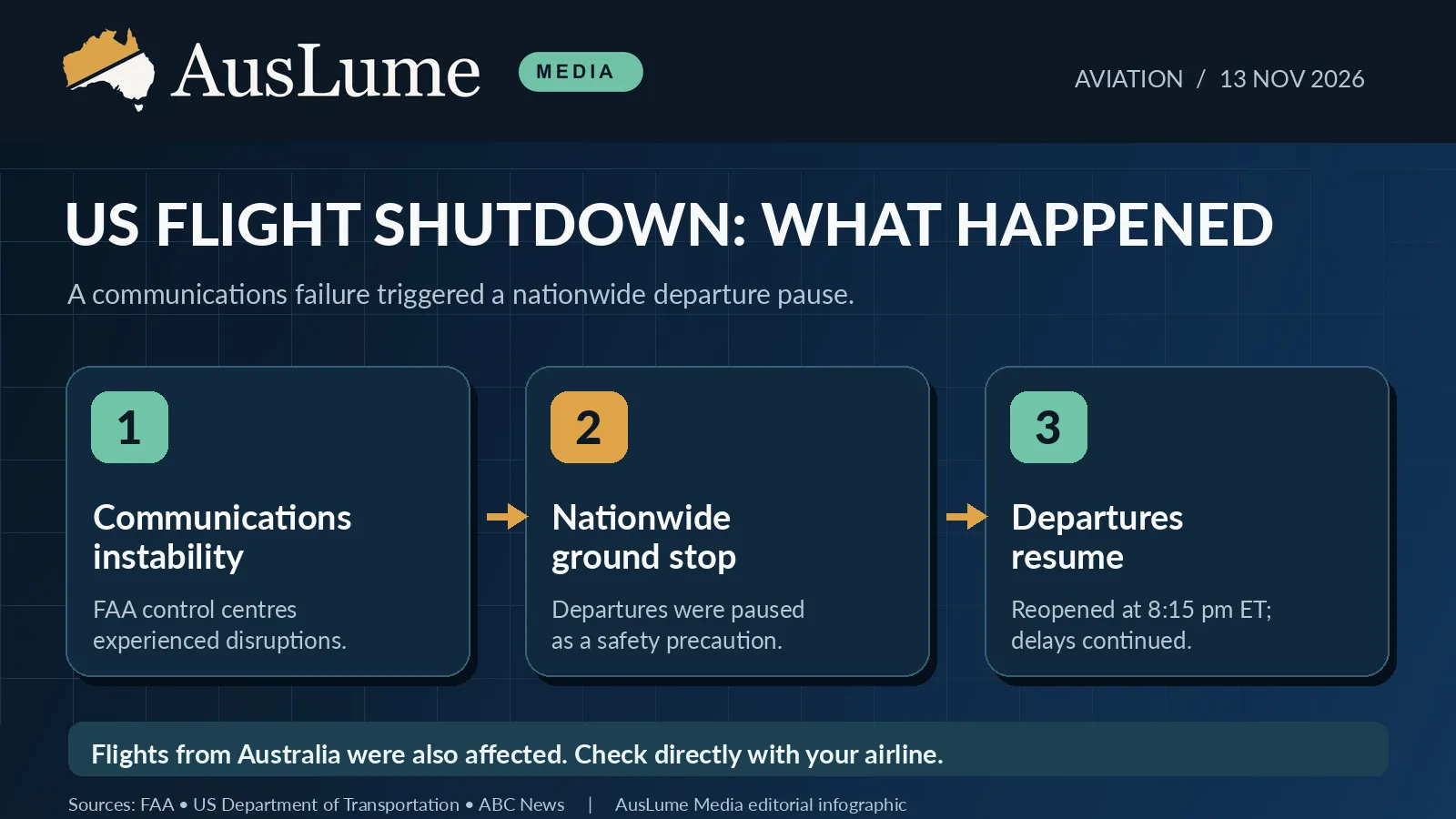
The disruption began on Friday afternoon in the United States when air traffic controllers experienced problems with communications and radar information.
The Federal Aviation Administration issued a nationwide ground stop as a safety precaution.
A ground stop prevents affected aircraft from departing, reducing the number of planes entering airspace while controllers manage a developing problem.
The decision was particularly significant because the interruption affected multiple air traffic control centres simultaneously.
US Transportation Secretary Sean Duffy said communications instability began around 3:36 pm Eastern Time.
He explained that ageing telecommunications equipment, including routers and switches, became overloaded with data, producing inconsistencies in the information available to controllers.
The equipment problems affected the reliability of radar and communication systems used to manage flights.
Authorities responded by limiting new departures while aircraft already in the air continued towards safe landing arrangements.
The immediate equipment problem was addressed, but investigators were continuing to examine the underlying failure and the circumstances surrounding it.
How many flights were cancelled or delayed?
The shutdown caused widespread disruption across the American aviation network.
According to Reuters, more than 4,700 flights were cancelled and approximately 10,000 were delayed on Friday, 13 November, US time.
The figures continued to change as airlines adjusted flight schedules and worked to restore services.
Major airports affected included New York's John F. Kennedy International Airport, Los Angeles International Airport and other important domestic and international aviation hubs.
Passengers experienced cancelled departures, missed connections, revised itineraries and extended waiting times.
The disruption also affected international journeys involving passengers travelling through the United States.
Even after the ground stop was lifted, airlines faced the challenge of repositioning aircraft and crews to resume normal operations.
Australian travellers caught in the disruption
Australian travellers were among those affected by the aviation shutdown.
Some flights departing Sydney Airport for the United States were temporarily grounded on Saturday, 14 November, Australian time.
Melbourne Airport also experienced delays to US-bound services, including flights to Los Angeles, Dallas and San Francisco.
Brisbane departures were affected as well.
The disruption was not limited to passengers leaving Australia.
Australians already travelling within the United States also faced cancelled flights and unexpected changes to their plans.
ABC News reported that Adelaide traveller Trish Crabb was stranded at New York's JFK Airport after her flight to Miami was grounded.
Her experience reflected the wider difficulties facing travellers who depended on domestic US connections.
For Australians visiting multiple American destinations, a cancelled connecting flight could also interfere with accommodation bookings, onward international flights and planned activities.
When did flights resume?
US authorities lifted the nationwide ground stop at approximately 8:15 pm Eastern Time on Friday, 13 November.
That was early Saturday afternoon in Sydney.
Transportation Secretary Sean Duffy confirmed that the airspace had reopened but warned that the restart would be gradual.
Airlines could not immediately restore every scheduled departure because some aircraft and flight crews were no longer in the correct locations.
Other flights had missed their allocated departure windows.
This meant that reopening US airspace did not automatically resolve the backlog of cancellations and delays.
Airlines began working to reorganise their schedules, but passengers were warned that disruptions could continue.
Australia's Smartraveller service subsequently confirmed that the nationwide ground stop had been lifted while delays and cancellations remained possible.
Was the disruption caused by a cyberattack or artificial intelligence?
US authorities said there was no evidence that a cyberattack caused the aviation failure.
Homeland Security Secretary Markwayne Mullin said the preliminary investigation pointed towards a telecommunications problem.
Officials nevertheless indicated that investigations were ongoing.
The incident also prompted questions about whether a newly introduced artificial intelligence-related aviation system had contributed to the disruption.
US Transportation Secretary Sean Duffy rejected that suggestion.
He explained that the FAA's SMART system, which helps identify possible improvements to air traffic management, was separate from the equipment involved in the failure.
The government's explanation focused on ageing telecommunications infrastructure and overloaded equipment.
There was also speculation about a connection to the separate Microsoft global outage.
Microsoft said it had no indication that the FAA disruption was related to its services.
The two incidents should therefore be treated as separate events unless subsequent investigations establish otherwise.
Why did the FAA stop flights across the country?
Air traffic control relies on consistent communication between aircraft and controllers.
Controllers need dependable information about aircraft positions, directions and movements to maintain safe separation.
When communications or radar information becomes unreliable, additional departures can increase the complexity of managing aircraft already in the sky.
The FAA's nationwide ground stop was a precaution intended to reduce that risk.
Aircraft already airborne were permitted to continue under established safety procedures, with controllers prioritising safe arrivals.
US officials reported that thousands of aircraft were brought safely to the ground during the disruption.
Although the grounding created significant inconvenience, aviation authorities maintained that passenger and crew safety remained the overriding consideration.
What should Australian travellers do now?
Australians travelling to or through the United States should take several practical precautions while airline schedules recover.
Check your flight status before leaving for the airport
Use your airline's official website or mobile application to confirm departure and arrival information.
Avoid relying solely on the original itinerary because flight times may change.
Contact your airline or travel agent
The Australian Travel Industry Association advised passengers travelling within the following 72 hours to contact their airline or travel provider if they had not received updated information.
Passengers travelling later were encouraged to allow providers to prioritise more urgent bookings.
Review connecting flights
Travellers with domestic connections in the United States should check the entire journey.
A delay on the first flight could affect subsequent departures, particularly where flights are booked separately.
Keep records of additional expenses
Passengers who experience unexpected accommodation, transport or meal expenses should keep their receipts.
Whether reimbursement is available will depend on the relevant airline conditions, applicable law and travel insurance policy.
Check travel insurance
Travellers should review their policy conditions for delays, cancellations and additional travel expenses.
Not every policy provides the same coverage, particularly when disruption arises from air traffic control problems rather than an airline's own operations.
Follow official Australian travel advice
Smartraveller provides updated information for Australians visiting the United States.
Its advice was updated to reflect the nationwide grounding and subsequent reopening of US airspace.
Why does one communications failure affect so many flights?
Modern aviation operates as a highly interconnected transport network.
An aircraft travelling from Australia to the United States may later operate several domestic or international flights.
When one scheduled departure is cancelled, the disruption can affect subsequent services using the same aircraft.
Flight crews must also meet working-hour and rest requirements.
If delays prevent a crew from operating its next scheduled service, the airline may need to arrange a replacement or cancel another flight.
Airports also have limited gates, runway capacity and ground-handling resources.
These constraints help explain why a relatively short interruption can produce consequences lasting well beyond the original incident.
Could another US aviation shutdown happen?
US authorities have acknowledged that the aviation system requires significant modernisation.
The November outage renewed attention on ageing telecommunications equipment and the need for more resilient air traffic control infrastructure.
Transportation Secretary Sean Duffy has called for additional investment in modernising the national system.
However, an exact timeline for preventing similar equipment failures has not been established.
Future reliability will depend on technical improvements, maintenance, contingency systems and the findings of the ongoing investigation.
What happens next?
The FAA and other US authorities are continuing to investigate the communications failure.
Airlines are working to restore regular flight schedules and manage passengers affected by cancellations and delays.
For Australian travellers, the most important immediate step is to confirm flight arrangements directly with their airline before travelling to the airport.
The wider incident raises questions about how well critical aviation infrastructure can withstand failures in an increasingly connected global transport system.
The US ground stop has ended, but its consequences demonstrate how a technical problem in one country's aviation network can disrupt travel thousands of kilometres away.

About the author
RullikClear, sourced explainers on Australia and the world
Rullik is the pen name of the founder of Australia Illuminate (Auslume). Rullik writes plain-language explainers on life in Australia, from immigration, study and work to money, sport and screen culture, always linking to the official sources behind each story. Every story is reviewed before publication.
More from Rullik ↗Image credits
- Three-stage infographic illustrating the communications instability, nationwide ground stop and reopening of US airspace at 8:15 pm Eastern Time.: Original AusLume Media infographic using official branding. Information sourced from the FAA and US Department of Transportation.
Sources
- https://www.faa.gov/newsroom/faa-statement-nationwide-ground-stop
- https://www.transportation.gov/briefing-room/icymi-us-transportation-secretary-sean-p-duffy-announces-lifting-nationwide-ground
- https://www.smartraveller.gov.au/destinations/americas/united-states-america
- https://www.abc.net.au/news/2026-11-14/australians-stranded-in-us-amid-flight-cancellations-chaos/107385998
- https://www.abc.net.au/news/2026-11-14/what-we-know-about-the-us-flight-groundstop/107385910
- https://www.reuters.com/world/us/faa-issues-national-ground-stop-due-extraordinary-circumstance-reasons-safety-2026-11-13/
- https://www.theguardian.com/australia-news/2026/nov/14/us-bound-flights-out-of-australia-grounded-as-telecommunications-outage-affects-american-travel