Most Australian children play organised sport. Far fewer keep playing it into adulthood, and the drop comes earlier and faster than many parents might expect. That is the clearest message in new research from the Australian Sports Commission.
The report, *Lifelong participation in sport*, is published on the Commission's AusPlay publications page. It uses AusPlay, the national survey of sport and physical activity, to look at how people play and help out in sport at different stages of life.
How the research was done
AusPlay moved from phone to online data collection in July 2023. According to the Commission's AusPlay results page, that change created a break in the time series, so comparisons with older figures need care.
Most of the report uses data collected between 1 July 2024 and 30 June 2025. That covers 41,820 Australians aged 15 and over, plus 8,829 children aged 0 to 14 whose parent or guardian answered for them. Charts that break results down by demographic group combine two years of data, July 2023 to June 2025, to make them more reliable.
The report counts people who took part in organised sport at least once a year, and it looks at non-playing roles too: coaches, officials, team managers and club volunteers.
What the researchers found
Organised sport peaks in the primary school years. Participation in organised sport is highest for children aged 9 to 11, and club participation peaks slightly later, at 12 to 14.
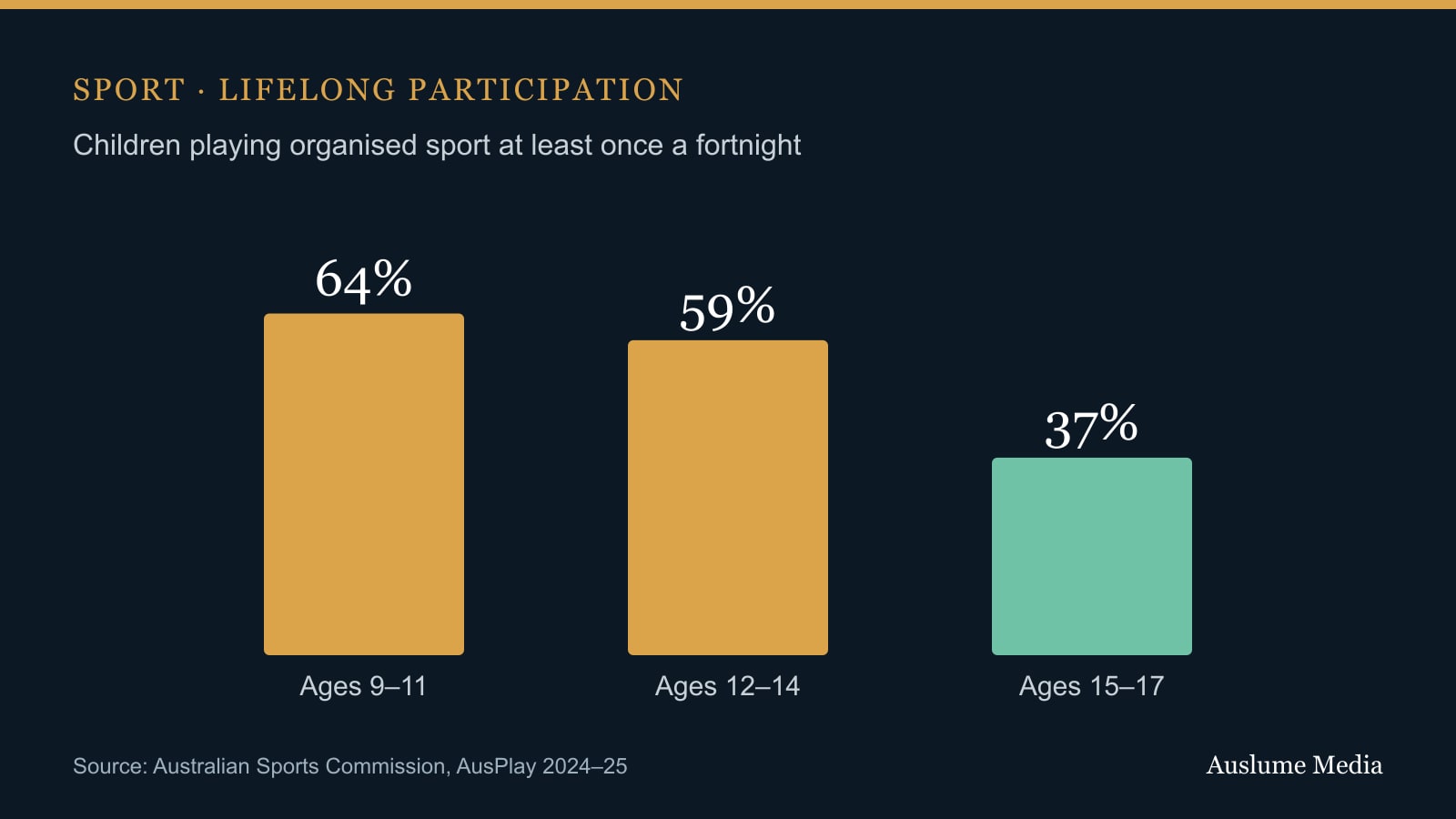
The drop after 14 is steep. Looking at children who play organised sport at least once a fortnight, participation is 64 per cent at ages 9 to 11 and 59 per cent at 12 to 14. At 15 to 17 it falls to 37 per cent.
Informal sport holds up better, for a while. Almost two-thirds, 61 per cent, of 15 to 17 year olds still play informal sport. From there, informal, organised and club sport all decline with age, but the decline slows.
Teenagers are the most likely to quit. The share of organised sport participants who have dropped, or are thinking of dropping, at least one of their sports is highest between 15 and 17.
Older players tend to stay. There are fewer organised sport participants aged 55 and over, but most of them are likely to continue.
Coaching drops off for women. Women coach at a similar rate to men in their mid-to-late teens and early twenties. After that, female involvement in coaching drops sharply, while men's is steadier until their mid-fifties.
Limitations
AusPlay is a large survey, but it relies on what people report about themselves, and parents answer for young children. The move to online collection means the current results cannot be compared directly with those before July 2023. Some demographic questions are not asked of 15 to 17 year olds, so those age groups are missing from some breakdowns. And the report describes patterns, not causes: it shows when people stop playing, not why.
Why it matters
If you are a parent, coach or club volunteer, the mid-teens are the pressure point. That is when school, work, cost and changing interests compete with sport, and when clubs lose the most players.
For clubs, the findings point to where effort is likely to pay off: keeping teenagers involved, whether as players, young coaches or officials, and giving women reasons to stay in coaching past their early twenties.
The Commission's next AusPlay release, covering July 2025 to June 2026, is scheduled for late October 2026.
This summary reports published research. It is general information.

About the author
RullikClear, sourced explainers on Australia and the world
Rullik is the pen name of the founder of Australia Illuminate (Auslume). Rullik writes plain-language explainers on life in Australia, from immigration, study and work to money, sport and screen culture, always linking to the official sources behind each story. Every story is reviewed before publication.
More from Rullik ↗