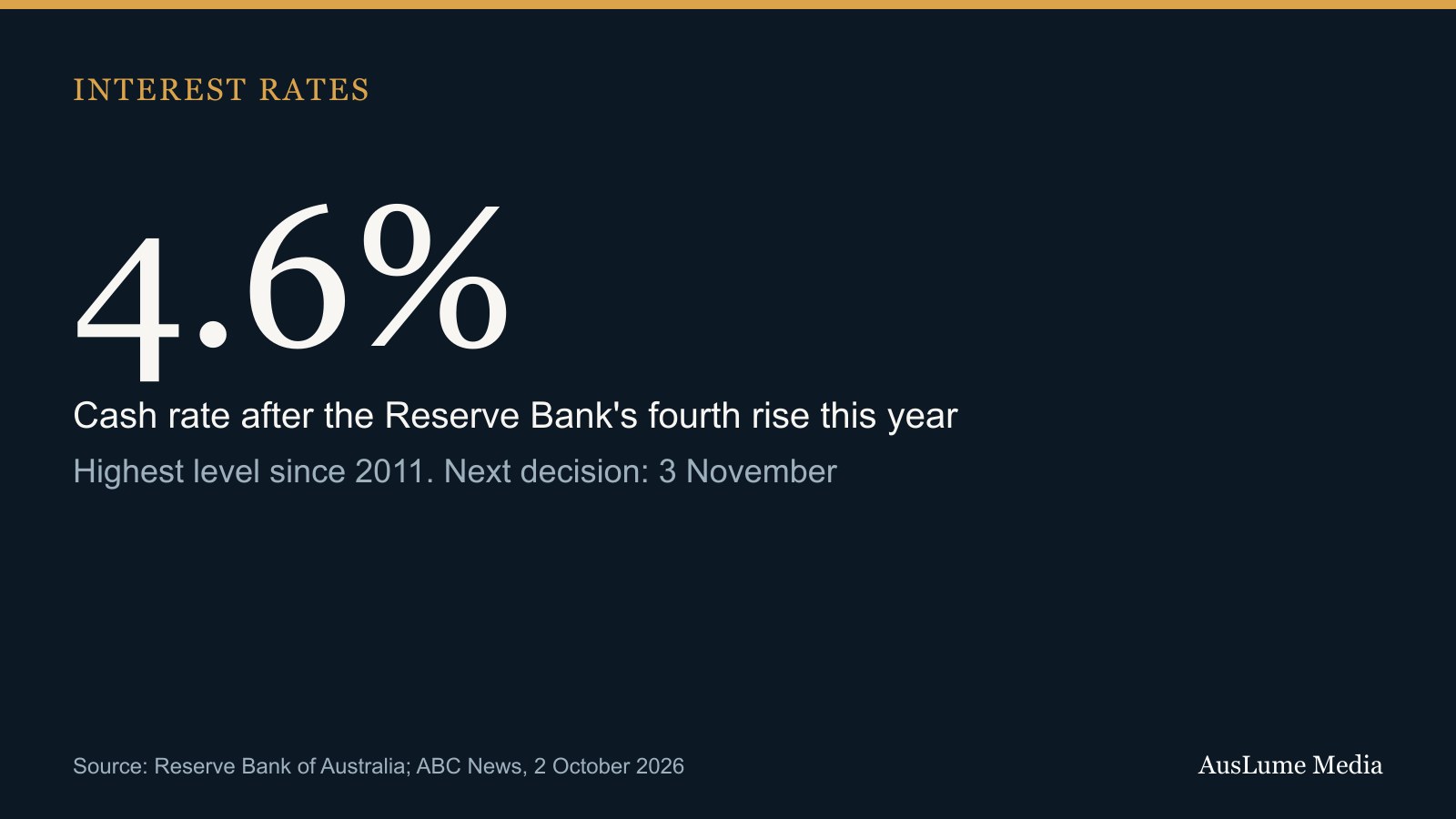
The Reserve Bank of Australia lifted the cash rate to 4.6 per cent this week, its fourth rise this year and the highest level since 2011, the ABC reported. The Reserve Bank publishes each decision on its cash rate decisions page.
Is this the last rise?
Commonwealth Bank chief executive Matt Comyn told the ABC he believes the Reserve Bank has finished raising rates for now, but that the board's November meeting is "live" and another rise remains possible, according to the ABC. That is his view, not a forecast from the Reserve Bank.
The next inflation figures are released at the end of October, and the Reserve Bank board meets on 3 November.
How higher rates are landing
Mr Comyn said the bank had seen 13 per cent growth in business lending across the 2026 financial year. He also said he expects property prices to pick up again, citing rising demand and a "structural undersupply of housing". Again, that is his opinion.
In regional Queensland, the picture is tougher. Nick and Amanda Kuhn run an organic egg business in Tiaro, about 220 kilometres north of Brisbane, and told the ABC that balancing rising costs with fair prices is "a fine balancing act". Mr Kuhn said his own home mortgage repayments had risen by "roughly $1,000 a month" because of the rate rises.
A survey reported in the same ABC story found 95 per cent of Queensland businesses were feeling the impact of higher fuel prices, and at least 60 per cent reported higher costs from freight, transport and cash flow. Small operators also warned that repeated rate rises and a recent ban on card surcharges would add pressure.
CQ University regional economics professor John Rolfe said it could take up to 18 months for this week's rise to "wash through the system".
What to watch, and what you can do
End of October: the next inflation figures.
3 November: the Reserve Bank's next decision.
If you have a variable-rate loan, check your current repayment and what a further rise would mean for your budget. Your lender can confirm the figures.
If repayments are getting hard to meet, contact your lender early and ask about hardship options.
This is general information, not financial advice.

About the author
RullikClear, sourced explainers on Australia and the world
Rullik is the pen name of the founder of Australia Illuminate (Auslume). Rullik writes plain-language explainers on life in Australia, from immigration, study and work to money, sport and screen culture, always linking to the official sources behind each story. Every story is reviewed before publication.
More from Rullik ↗This article was prepared with AI assistance.