Australia's permanent migration program for 2026–27 is the same size as last year: 185,000 places. What has changed is who gets them. More places are going to people already living here, and the mix inside the skilled stream has shifted noticeably.
The Government announced the settings on 12 May 2026, alongside the Budget. The Department of Home Affairs sets out the full breakdown on its planning levels page, and the measure appears in Budget Paper No. 2.
The headline numbers
The program keeps its rough 70:30 split between skilled and family visas:
Skilled Migration Program: 132,240 places, about 71 per cent.
Australian Family Program: 52,460 places, about 28 per cent.
Special Eligibility: 300 places.
Across the skilled and family streams, 129,590 places are allocated to migrants already living in Australia. The Budget paper says the remaining 55,110 offshore places will mostly go to high-skilled migrants who help meet long-term skill needs.
Where the skilled places moved
The overall skilled number barely moved, from 132,200 to 132,240. Inside it, the changes are large.
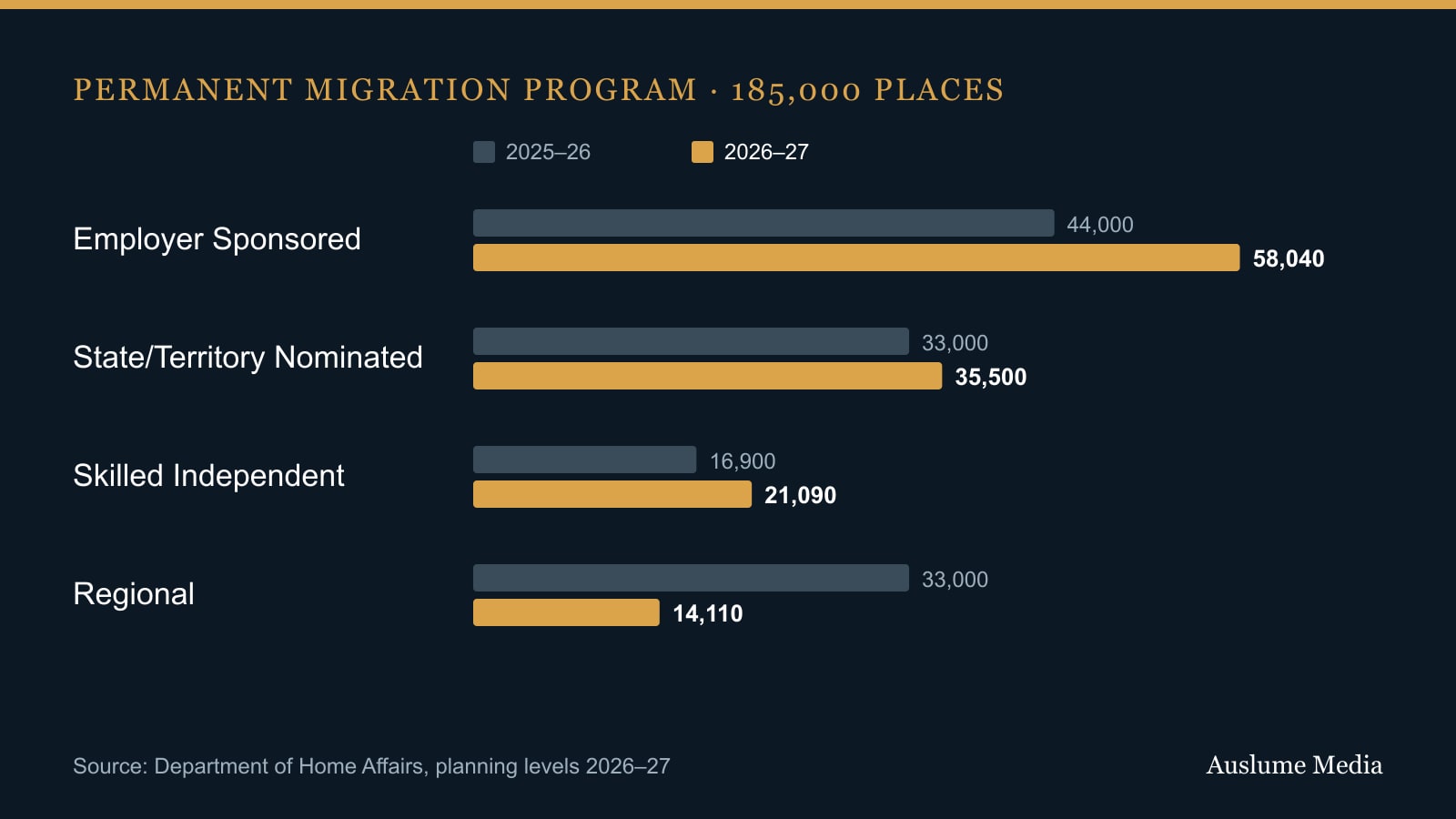
Employer Sponsored rises from 44,000 to 58,040.
Skilled Independent rises from 16,900 to 21,090.
State and Territory Nominated rises from 33,000 to 35,500.
Regional falls from 33,000 to 14,110.
Talent and Innovation falls from 5,300 to 3,500.
The Regional category covers the Skilled Work Regional (provisional) subclass 491 visa. If you were planning around a regional nomination, that is the number to watch. Fewer than half as many places are set aside for it this year, although state and territory nominated places overall have grown and regional employers can still use employer sponsorship and Designated Area Migration Agreements.
The department says the Skilled Independent increase reflects the visa's strong record of highly skilled employment and positive fiscal outcomes, and that the Employer Sponsored increase supports timely transitions to permanent residence for temporary migrants who are filling skill gaps.
Family visas
The family program is almost unchanged in size. Partner places rise from 40,500 to 41,500 and Child places from 3,000 to 3,500. Parent places fall from 8,500 to 7,060 and Other Family from 500 to 400.
Partner and Child visas are demand driven. The planning figures for them are indicative, used for planning and resourcing, rather than hard caps.
Why the onshore focus matters
Permanent visas do not add much to population growth when most of them go to people who are already here. The department notes that in 2024–25, 61 per cent of permanent skilled visas and 39 per cent of permanent family visas were issued to people already onshore.
Net overseas migration includes temporary movements such as students and working holiday makers, as well as Australians and New Zealanders coming and going. The department says it has fallen more than 40 per cent from its 2023 peak. Directing permanent places to people already here gives them a clearer path to residency while keeping the program's effect on overall migration numbers low.
What this means if you are applying
A few practical points:
Planning levels are not processing guarantees. They set how many visas can be granted across the year. Processing priorities and timing are set separately.
Check your state or territory. Each jurisdiction runs its own nomination criteria and allocations for subclass 190 and 491 visas, and those can change during the year.
Onshore applicants are the priority. If you are already in Australia on a temporary visa and eligible for a permanent pathway, the settings are designed to favour you.
The Budget paper also flags a planned reform of the points test used for many skilled visas. Details of that reform are not yet in the planning levels, so treat any claims about new points rules with caution until Home Affairs publishes them.
This article explains published program settings. It is general information, not migration advice. For your own situation, speak to a registered migration agent or check the Home Affairs website directly.

About the author
RullikClear, sourced explainers on Australia and the world
Rullik is the pen name of the founder of Australia Illuminate (Auslume). Rullik writes plain-language explainers on life in Australia, from immigration, study and work to money, sport and screen culture, always linking to the official sources behind each story. Every story is reviewed before publication.
More from Rullik ↗