An auction clearance rate is the share of homes taken to auction that end up selling. When it falls, more homes are being passed in without a sale.
What the latest figures show
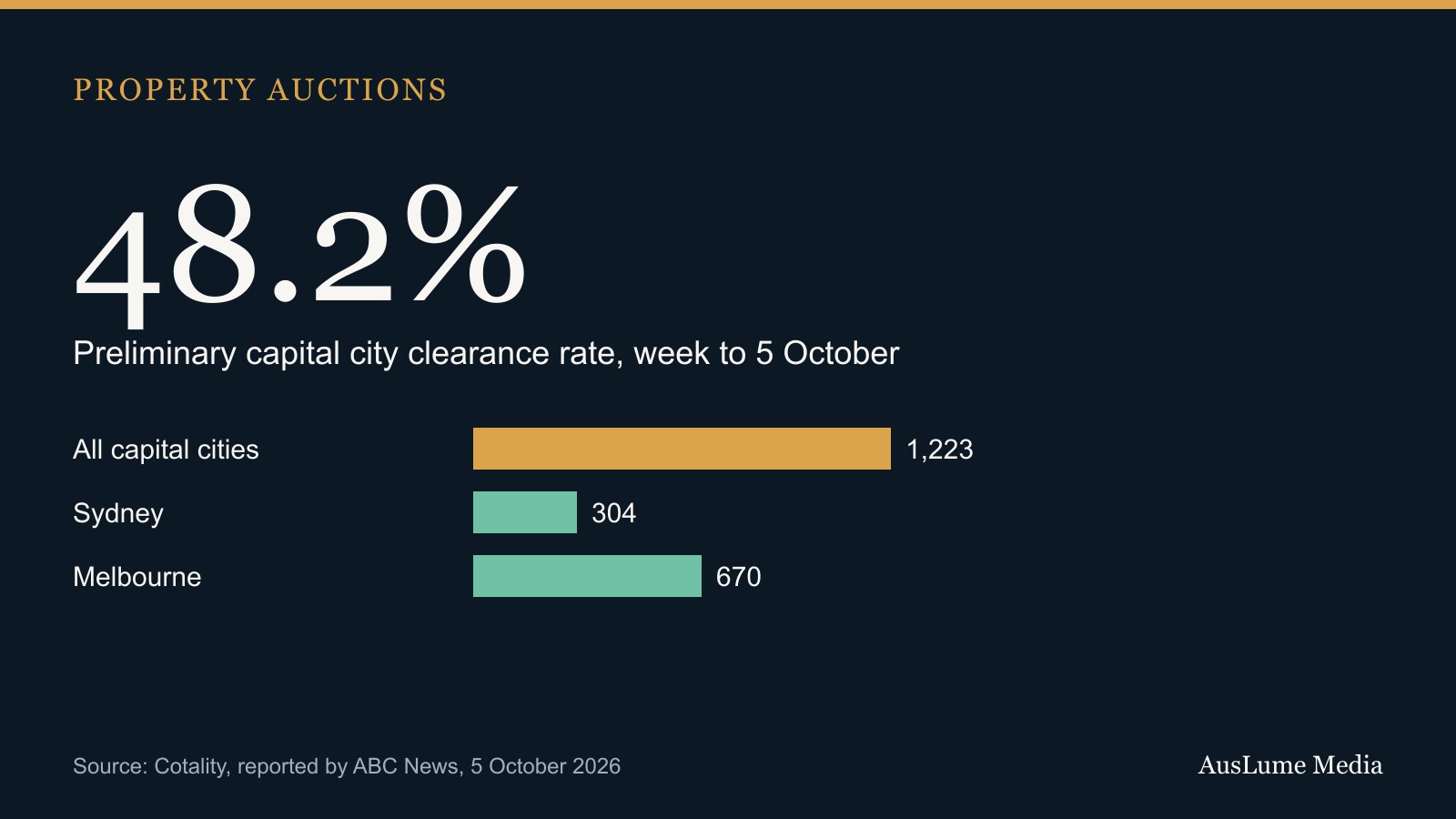
The preliminary clearance rate for the week to 5 October was 48.2 per cent, the lowest since late June (47.4 per cent) and the second-lowest preliminary reading this year, the ABC reported, citing property research firm Cotality.
Fewer homes are going to auction, too. According to Cotality's figures in the same ABC report:
1,223 auctions were held across the capital cities, 12.8 per cent fewer than the week before and 47.5 per cent fewer than a year ago.
Sydney held 304 auctions, down 61 per cent on the previous week.
Melbourne held 670 auctions, and its number of auctions has fallen 45.6 per cent over the past 12 months, the largest drop of any capital city.
Cotality research director Tim Lawless said the weak result followed long weekends in some states and the Reserve Bank's decision to lift interest rates for a fourth time this year, adding that Sydney and Melbourne "have been a drag on the national result".
Homes are taking longer to sell
Separate data from SQM Research, also reported by the ABC, shows some homes sitting unsold for as long as six months. Listings older than 180 days rose 10.5 per cent on a year earlier, and the number of unsold homes across the country reached 276,000, up 21.6 per cent. SQM also counted 4,872 distressed sales in September, 29 per cent more than a year before.
The ABC's markets coverage on the same day also noted the housing market weakening as clearance rates fell.
What it may mean (opinion, not fact)
Some economists predict capital city property prices could fall 10 to 15 per cent from peak to trough, the ABC reported. That is a forecast, and forecasts can be wrong.
For buyers, a weaker auction market can mean less competition and more room to negotiate. For sellers, it can mean a longer campaign and offers below expectations.
What you can do
Check recent clearance rates and sale results in your own suburb, not just city-wide figures.
If you are selling, ask your agent how long similar homes have taken to sell, and plan for a longer timeline.
If you are buying, homes that have been listed for a long time may be open to negotiation.
This is general information, not financial advice.
This explainer was drafted with the help of an AI model running on our own equipment, from the ABC reports linked above, then checked against those reports and edited by AusLume Media before publication.

About the author
RullikClear, sourced explainers on Australia and the world
Rullik is the pen name of the founder of Australia Illuminate (Auslume). Rullik writes plain-language explainers on life in Australia, from immigration, study and work to money, sport and screen culture, always linking to the official sources behind each story. Every story is reviewed before publication.
More from Rullik ↗This article was prepared with AI assistance.