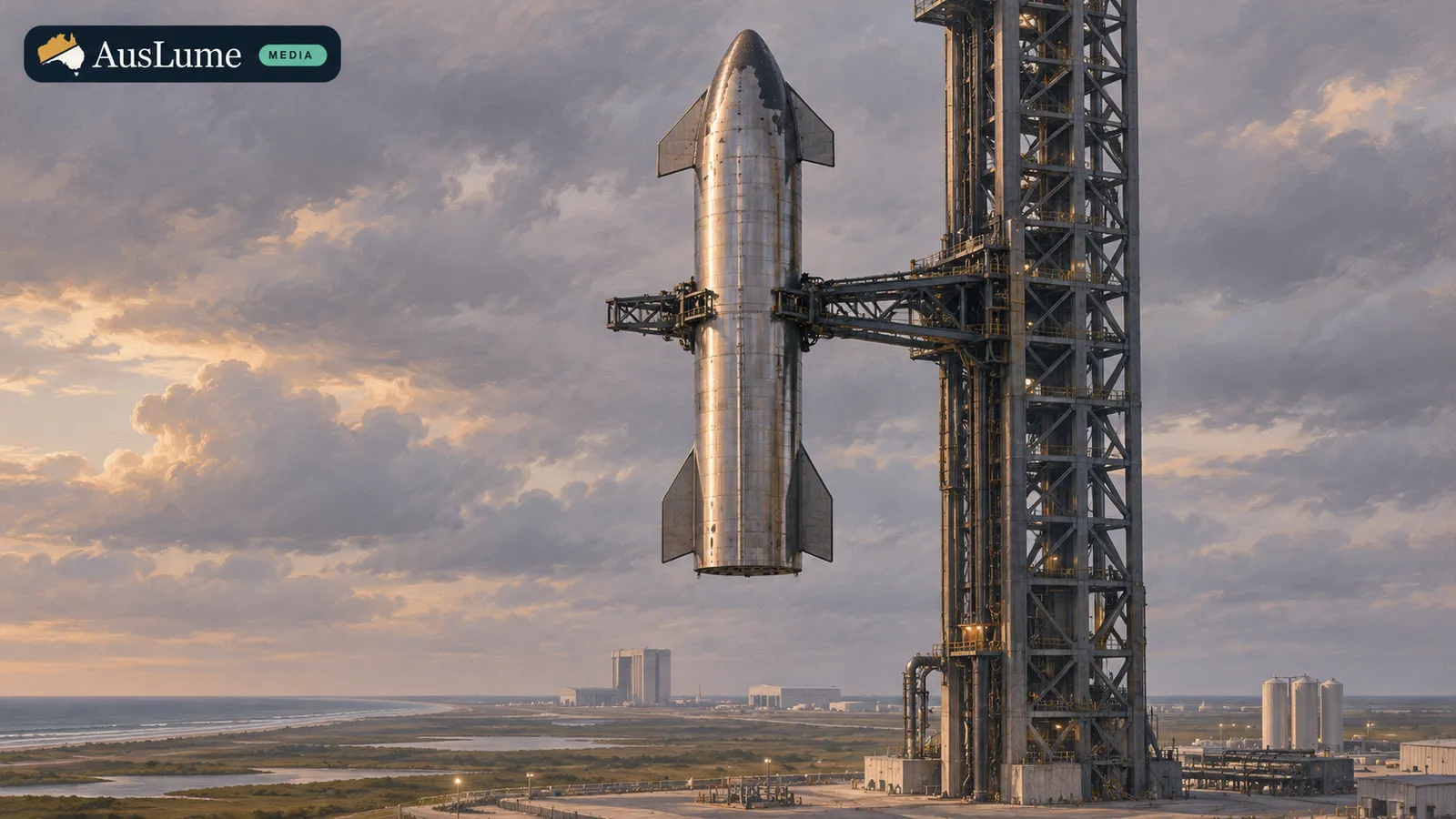
The SpaceX Starship catch on 14 November 2026 has marked a significant milestone in commercial space exploration. The company successfully recovered its upper-stage spacecraft after an orbital mission lasting approximately 22.5 hours, although its attempt to recover both stages of the rocket did not succeed.
The spacecraft was caught by mechanical arms attached to the launch tower at SpaceX's Starbase facility in Texas, United States.
Key points
SpaceX achieved its first successful tower catch of Starship's upper stage.
The spacecraft completed 14 orbits around Earth.
The mission deployed 26 next-generation Starlink satellites.
The Super Heavy booster was destroyed after its planned recovery was abandoned.
The achievement supports SpaceX's development of fully reusable launch systems.
What happened during Starship Flight 15?
Starship lifted off from Starbase on Friday, 13 November, local time, on its fifteenth integrated test flight.
After separating from the Super Heavy booster, the upper-stage spacecraft continued into low Earth orbit, where it successfully deployed 26 Starlink V3 satellites.
The spacecraft completed 14 revolutions around Earth before beginning its return journey.
After surviving atmospheric re-entry, Starship approached the launch tower in an upright position. Two large mechanical arms, commonly known as chopsticks, secured the spacecraft above the ground.
The recovery took place on Saturday afternoon in Texas, corresponding to Sunday morning in eastern Australia.
According to Associated Press reporting, this was the first successful tower recovery of a Starship spacecraft returning from orbit.
Flight 15 results at a glance
Mission objective | Outcome |
|---|---|
Launch and stage separation | Successful |
Super Heavy booster recovery | Unsuccessful |
Orbital flight | Successful |
Satellite deployment | 26 satellites deployed |
Earth orbits completed | 14 |
Starship upper-stage recovery | Successful |
Recovery of both stages | Not achieved |
What happened to the Super Heavy booster?
The mission did not achieve all its objectives.
SpaceX originally intended to recover both the Super Heavy booster and the Starship spacecraft at the launch facility.
However, the booster abandoned its planned return to the tower after detecting a problem during its return flight. It was redirected offshore and subsequently destroyed over the Gulf of Mexico.
SpaceX indicated that an early termination of the boostback engine burn may have been associated with a low-fuel-mass alarm.
Engineers are investigating the underlying cause.
Although SpaceX had previously recovered earlier versions of Super Heavy, Flight 15 did not achieve its planned double recovery.
Why the Starship catch matters
Conventional expendable rockets discard major components after launch. SpaceX is developing Starship with the intention of recovering and repeatedly using both stages.
The long-term objective is to reduce launch costs while increasing the frequency and capacity of space missions.
Recovering the upper stage presents additional engineering challenges because the spacecraft must withstand the extreme conditions of returning from orbital flight.
A reliable recovery system could eventually support:
Larger commercial satellite deployments.
More frequent scientific missions.
Transportation of equipment to the Moon.
Future deep-space exploration.
Reduced reliance on manufacturing new launch vehicles for every mission.
However, recovering a spacecraft once does not demonstrate that it can be rapidly and economically reused on a routine basis. Further testing and inspections will be necessary.
What does this mean for NASA's Artemis programme?
NASA is working with SpaceX and Blue Origin to develop commercial lunar landing systems as part of its Artemis programme.
The agency currently plans to conduct Artemis III in Earth orbit in 2027. The mission will test docking procedures involving NASA's Orion spacecraft and test versions of the two commercial lunar landers.
NASA is targeting 2028 for its first crewed lunar landing since the Apollo era.
However, the agency has not yet selected which company will provide the lander for that first landing. The decision will depend on technical readiness and safety requirements.
SpaceX must also demonstrate other critical capabilities, including transferring propellant between spacecraft in orbit.
What comes next for SpaceX?
Flight 15 represents an important engineering milestone, but several development challenges remain.
SpaceX will need to investigate the booster failure, assess the recovered spacecraft and demonstrate that both stages can be reliably recovered and reused.
The company must also continue developing the technology required for future lunar and deep-space missions.
The successful Starship catch brings SpaceX closer to its original vision of a fully reusable space transportation system, but that objective has not yet been completely achieved.
Related stories

About the author
RullikClear, sourced explainers on Australia and the world
Rullik is the pen name of the founder of Australia Illuminate (Auslume). Rullik writes plain-language explainers on life in Australia, from immigration, study and work to money, sport and screen culture, always linking to the official sources behind each story. Every story is reviewed before publication.
More from Rullik ↗This article was prepared with AI assistance.
Sources
- https://www.spacex.com/launches/starship-flight-15
- https://new.spacex.com/vehicles/starship
- https://apnews.com/article/spacex-elon-musk-starship-rocket-df394c1b5a0f85e11194f9ff7db9ee6b
- https://www.space.com/space-exploration/launches-spacecraft/spacex-says-starship-flight-15-booster-aborted-chopsticks-landing-catch-after-launch-due-to-guidance-issue-video
- https://www.nasa.gov/missions/artemis/nasa-partners-accelerate-lander-development-for-2028-moon-missions/
- https://www.nasa.gov/missions/artemis/nasas-artemis-iii-mission-to-test-future-moon-lander-operations/