An investment advertisement sends you searching for reviews. Several look positive, so the offer seems legitimate. A scammer may have created those pages as well as the advertisement.
ASIC's latest warning describes networks of fabricated websites, endorsements and reviews that make an investment appear independently supported. Generative AI can help criminals produce the surrounding material as well as the initial pitch. A polished page or familiar face is therefore a poor substitute for checking who is actually making the offer. [1]
The regulator reports removing more than 19,400 online scams in the 2025-26 financial year. That is a count of takedown activity, not a count of all scams or a forecast of how likely a particular reader is to be targeted. [1]
Why several matching pages may prove very little
Imagine a fictional promotion called Harbour Future Income. An advertisement sends you to an apparent news article. A search finds a review page repeating the same claims. A video shows a recognisable person apparently praising the opportunity.
In this fictional example, the pages and video provide no independent verification. If they come from the same source, they simply repeat its claims. Look for evidence from a trustworthy source outside that chain.
This is particularly important when the presentation borrows the appearance of a newspaper, a government announcement or a trusted business. A logo is easy to display. Its presence does not establish that the organisation produced the page or supports the offer.
Change what you verify
Scamwatch's investment-scam guidance recommends checking an investment and the people involved, and warns about pressure to act quickly. It also explains that scammers may impersonate genuine organisations. [2]
Start your checks outside the advertisement's links. Find the organisation through an independent route, confirm its contact details and ask whether the offer comes from it. Someone using a real company's name may have no connection to that company.
Do not allow a countdown or a supposed limited allocation to remove the time needed for those checks. If the offer depends on you avoiding ordinary verification, the pressure itself is relevant information.
A realistic household response
If a family member forwards an offer, ask where it came from, how they checked the identity and whether they have sent money. Keep the conversation focused on checking the offer. Seek professional help where needed.
A simple pause can create space to check. Save the advertisement's address and the communication details without sending more documents or paying a small “verification” amount. Do not post personal information in public while trying to warn others.
If money has already been sent, Scamwatch advises contacting the bank or card provider immediately and reporting the scam. It links to IDCARE for identity and cyber support. [2] Speed matters more than constructing a perfect explanation of how the deception worked.
Why news publishers have a role
Publishers can accidentally promote the material they are warning about. A screenshot of a fake page needs a clear label so it cannot pass as genuine when shared elsewhere. Avoid turning a scam's contact details into a clickable promotion.
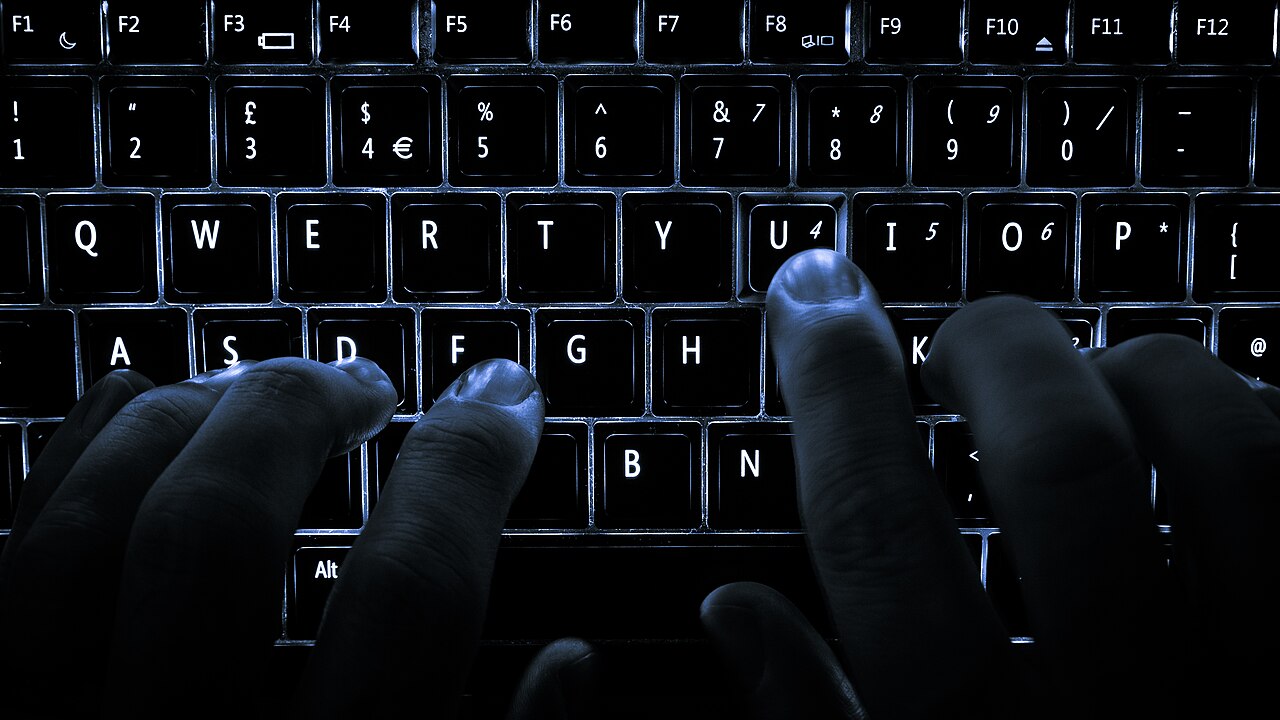
The keyboard photograph is illustrative. The example is fictional, and the person pictured is not identified as a scammer or victim.
Before paying, establish who is making the offer, whether they have authority to make it and where the money will go. Search results that repeat the same pitch do not establish those facts.
Image: Hands using an illuminated laptop keyboard. Illustrative file photo, not a person identified as a scammer or victim. Credit: Colin. Wikimedia Commons original. CC BY-SA 4.0. No image edits.

About the author
RullikClear, sourced explainers on Australia and the world
Rullik is the pen name of the founder of Australia Illuminate (Auslume). Rullik writes plain-language explainers on life in Australia, from immigration, study and work to money, sport and screen culture, always linking to the official sources behind each story. Every story is reviewed before publication.
More from Rullik ↗