Australia's ban on social media accounts for under-16s has been in force since 10 December 2025. The first official look at how it is working suggests it has changed a lot, but not nearly everything.
This report draws on the eSafety Commissioner's March 2026 compliance update and its age restrictions page, last updated on 15 September 2026.
What the law requires
Since 10 December 2025, age-restricted social media platforms must take reasonable steps to stop Australians under 16 from creating or keeping an account. In eSafety's view, the restricted platforms include Facebook, Instagram, Snapchat, Threads, TikTok, Twitch, X, YouTube, Kick and Reddit. That list can change.
The obligation falls on the platforms, not on families. There are no penalties for under-16s who use these services, or for their parents or carers. A court can order a platform that fails to take reasonable steps to pay up to 150,000 penalty units, which eSafety says is currently $54.6 million.
Children can still see publicly available content that does not need an account, such as most YouTube videos.
What the numbers show
Millions of accounts came down. Platforms removed or restricted 4.7 million age-restricted accounts by mid-December 2025, based on information they gave eSafety under legally enforceable notices. By the start of March 2026, more than 300,000 further accounts had been prevented from signing in.
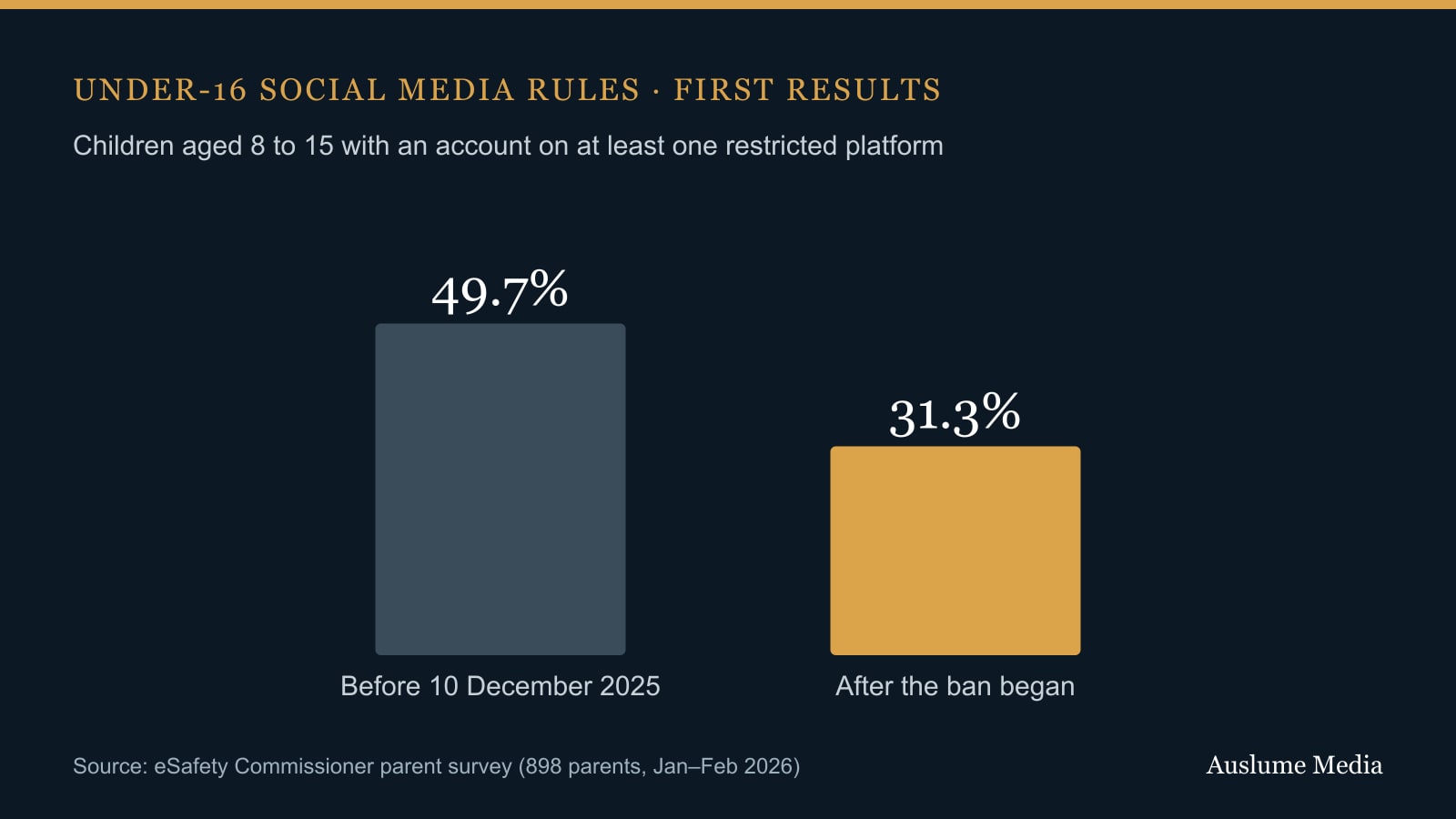
Fewer children have accounts, but many still do. eSafety surveyed 898 parents and carers of children aged 8 to 15 between 19 January and 2 February 2026. Before the restrictions, 49.7 per cent said their child had an account on at least one of the 10 platforms. Afterwards, 31.3 per cent did.
Among children who had an account on a platform before 10 December, around 7 in 10 still had one on Facebook (63.6 per cent), Instagram (69.1 per cent), Snapchat (69.4 per cent) and TikTok (69.3 per cent). For YouTube it was 48.5 per cent.
Most had simply not been asked. Where a child kept an account, the most common reason parents gave, at 66.8 per cent, was that the platform had not yet asked the child to verify their age. Where a child lost an account, the most common reason was that the platform deactivated it (43.6 per cent), followed by the child closing it (36.3 per cent) and a parent closing it (26.6 per cent).
Investigations
The March update says eSafety was investigating potential non-compliance by Facebook, Instagram, Snapchat, TikTok and YouTube. It aimed to finalise at least some of those investigations, and decide on any enforcement action, by the middle of 2026.
eSafety stresses that whether a platform has taken "reasonable steps" is ultimately a question for the courts, judged against the service, what is technically feasible and the wider regulatory setting. As at 26 September 2026, the March update was the latest compliance report listed on eSafety's page. We will update this story when eSafety reports on the outcome of its investigations.
Rule changes
On 25 March 2026 the Minister for Communications amended the rules that decide which platforms are covered. The change targets services with addictive or otherwise harmful design features. eSafety reassessed the platforms it had already identified and found its view had not changed.
The law also requires an independent review of how it is working, to begin within two years of 10 December 2025.
Limits of this evidence
The parent survey is a snapshot taken a few weeks after the law began, from parents' perspective. It cannot say what children do without their parents knowing. Account removal figures come from the platforms themselves. And an account removed is not the same as a child kept safe: eSafety itself says the restrictions will not eliminate every risk children face online.
For families
eSafety's advice for parents and young people is on its parents' page. If you believe a platform is not meeting its obligations, eSafety has a form to report it.
This report summarises official publications. It is general information, not legal advice.

About the author
RullikClear, sourced explainers on Australia and the world
Rullik is the pen name of the founder of Australia Illuminate (Auslume). Rullik writes plain-language explainers on life in Australia, from immigration, study and work to money, sport and screen culture, always linking to the official sources behind each story. Every story is reviewed before publication.
More from Rullik ↗