Home building approvals fell in July, and the country is running behind the pace needed to build 1.2 million homes by mid-2029. But the longer trend is still upward, and the picture differs sharply between states.
This report uses the Australian Bureau of Statistics' Building Approvals release for July 2026, published on 1 September, together with Treasury's Housing Accord page and the National Housing Supply and Affordability Council's first quarterly report.
The July figures
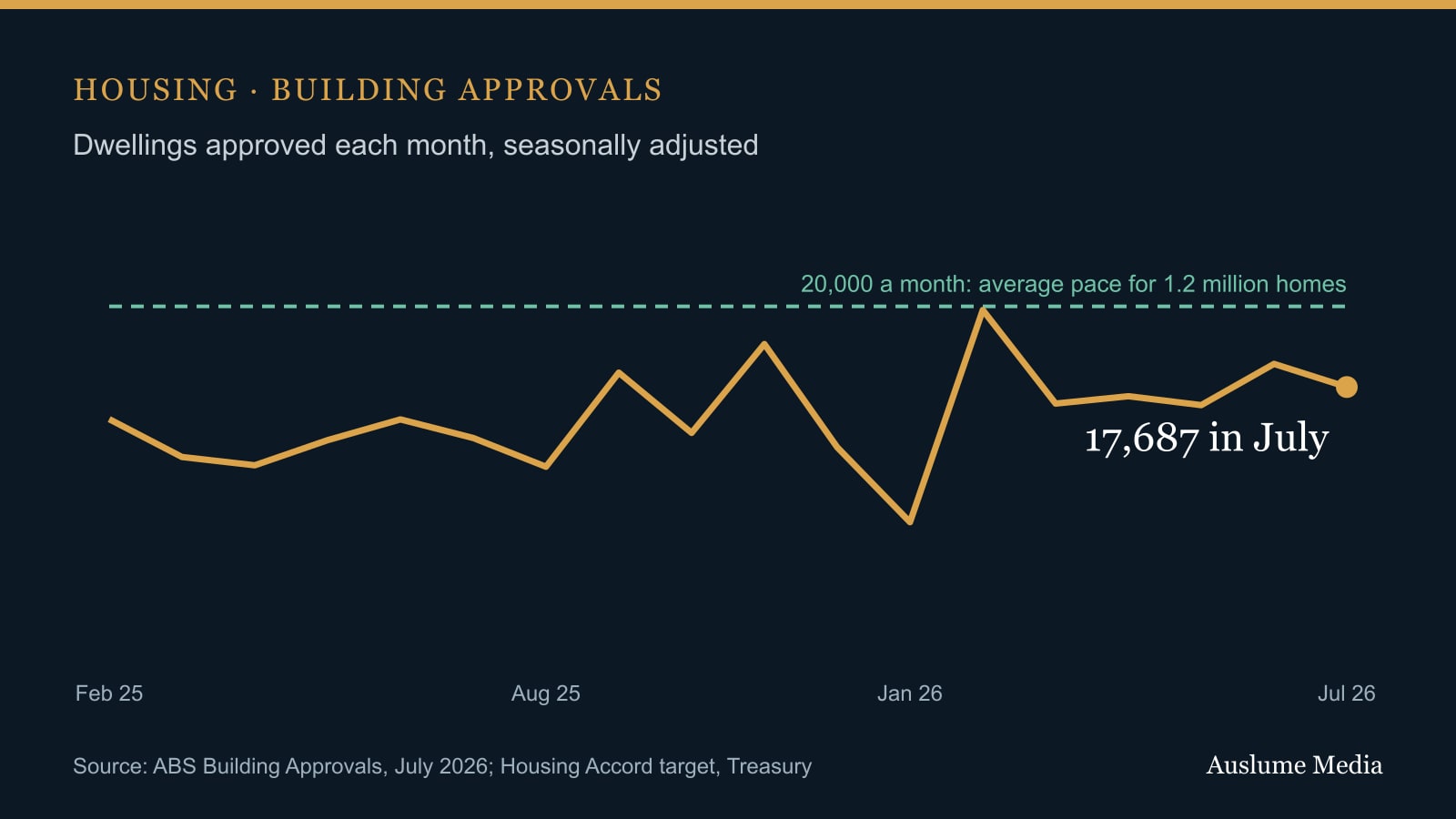
In seasonally adjusted terms, total dwellings approved fell 3.6 per cent in July to 17,687. That followed a 6.9 per cent rise in June.
Private sector houses fell 4.2 per cent to 10,199.
Private sector dwellings other than houses, mainly apartments and townhouses, fell 0.4 per cent to 7,119.
Monthly approvals jump around, especially for apartments, where one large project can move the numbers. The ABS trend estimate, which smooths out that noise, rose 0.8 per cent in July after a 0.9 per cent rise in June.
Across the states, approvals for total dwellings fell in Queensland (down 13.9 per cent), New South Wales (down 8.1 per cent) and Western Australia (down 0.3 per cent), and rose in Tasmania (up 15.2 per cent), Victoria (up 9.7 per cent) and South Australia (up 5.9 per cent). Approvals for private sector houses fell in every state reported.
The target
In August 2023, National Cabinet agreed to build 1.2 million new, well-located homes over five years from 1 July 2024. That works out to an average of 240,000 homes a year, or 20,000 a month.
On our calculation, adding up the ABS seasonally adjusted monthly figures, about 206,000 dwellings were approved in the 12 months to July 2026. Approvals are not completions. Some approved homes are never built, and others take a year or more to finish. But approvals are the earliest sign of what will be built, and they are running below the average pace the target implies.
How far along is the Accord?
The Council's first quarterly report gives the most complete official view of progress so far. It found:
about 219,000 new homes were completed over the first five quarters of the Accord
quarterly building approvals were 17 per cent higher than when the Accord started, comparing the three months to January 2026 with the June 2024 quarter
quarterly commencements were also up 17 per cent
building a new house had become 0.9 per cent cheaper in real terms, and 10 per cent faster.
The Council also estimates when each state would reach its share of the target at current rates. Victoria and Western Australia were on track for around September 2029, Queensland and South Australia around September 2030, and New South Wales not until around June 2031.
What it means
The five-year target was always ambitious. The data shows the building pipeline is improving, but not fast enough everywhere. New South Wales, the largest market, is furthest behind the pace.
For people trying to buy or rent, the practical effect is that new supply will keep arriving more slowly than hoped in some cities. Faster construction times and easing real building costs are the more encouraging signs in the Council's report.
Limits of these figures
Monthly approvals are volatile and revised. Our 12-month total uses seasonally adjusted figures, which will differ slightly from original counts. The Council's state completion dates are projections based on recent rates, not forecasts of policy success, and they will change as conditions change.
This report summarises official statistics. It is general information.

About the author
RullikClear, sourced explainers on Australia and the world
Rullik is the pen name of the founder of Australia Illuminate (Auslume). Rullik writes plain-language explainers on life in Australia, from immigration, study and work to money, sport and screen culture, always linking to the official sources behind each story. Every story is reviewed before publication.
More from Rullik ↗