
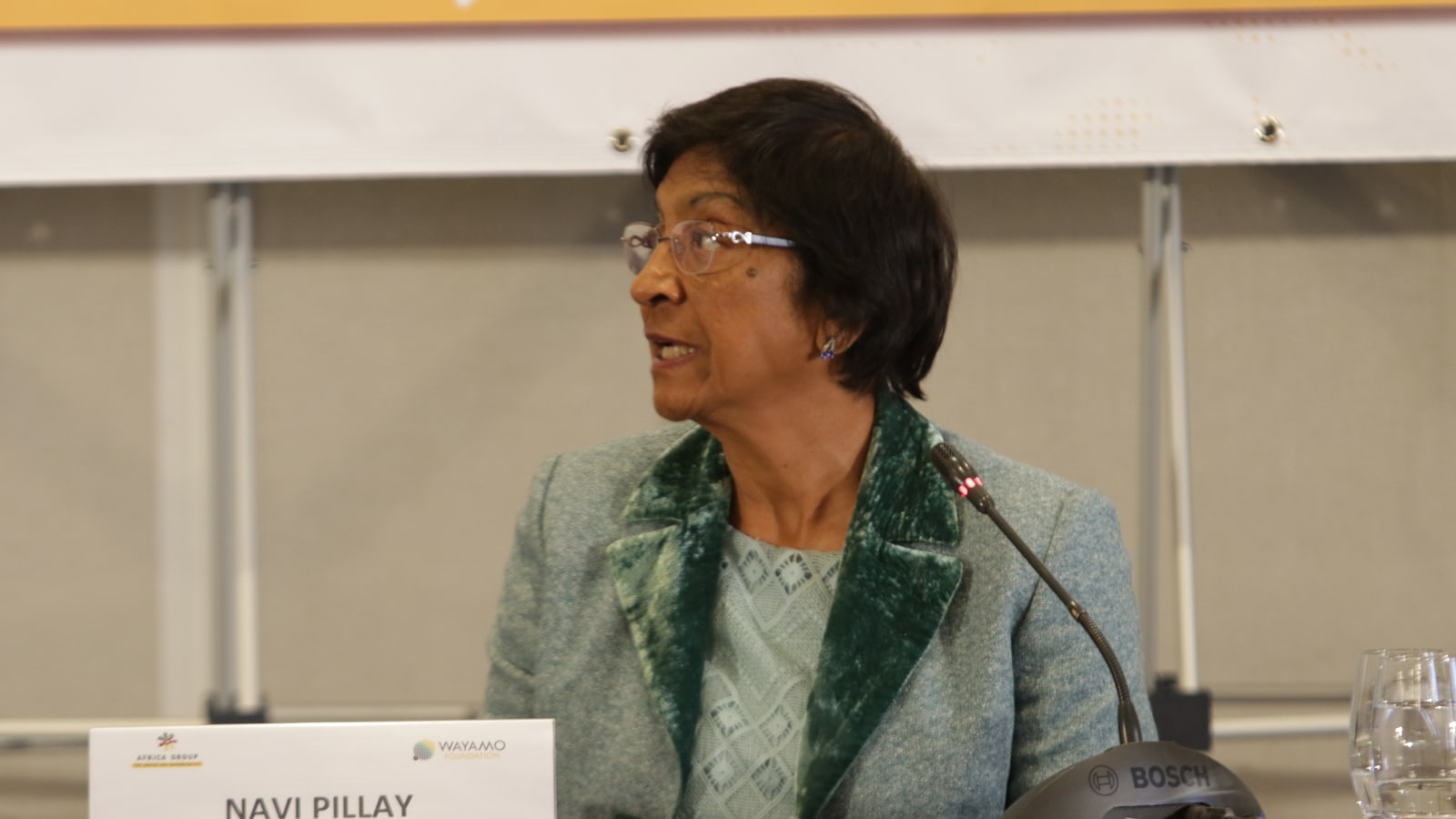
In short: South African judge Navi Pillay has won the 2026 Nobel Peace Prize for her efforts to promote peace and international law. The Norwegian Nobel Committee also used the award to warn that international law and its institutions are under pressure.
The 2026 Nobel Peace Prize has gone to a judge. The Norwegian Nobel Committee announced on 9 October that it had awarded the prize to Navanethem "Navi" Pillay "for her efforts to promote peace and international law".
In its announcement, the committee said Pillay had "significantly enlarged the scope and impact of international law" over a long career. It also used the award to make a wider point about the pressure it says international law is under.
Who is Navi Pillay?
According to the committee, Pillay was born into a family of Indian Tamil origin in Durban, South Africa, under apartheid. She became a lawyer, confronting deep structural discrimination, and her early work included defending Nelson Mandela and others who opposed apartheid.
The committee lists the roles that followed:
judge on the High Court in South Africa
judge on the International Criminal Tribunal for Rwanda
judge on the International Criminal Court
United Nations High Commissioner for Human Rights
until recently, chair of the UN Independent International Commission of Inquiry on the Occupied Palestinian Territory.
The committee says she now sits as a judge at the International Court of Justice in the case in which Myanmar is accused of genocide, brought by The Gambia. The court's case page sets out the proceedings.
Why the committee chose her
The committee's statement is as much about international law as about Pillay. It notes that the first Nobel Peace Prize was awarded 125 years ago, and says the committee has stressed resolving conflicts through law from the start.
It argues that international law "is no longer just a supplement to peace and security" but "an absolute necessity", at a time of more wars and conflicts than the world has seen in a long time. It also says the system is "under tremendous pressure" and its institutions "under attack", and that judges are being sanctioned. The committee does not name the countries or people it has in mind.
The statement acknowledges that the system has never been perfect. The greatest powers have often evaded responsibility, it says, and cases have produced different results depending on who the perpetrator and victim are.
What the committee says she achieved
The committee credits Pillay with showing, in historic cases, that legal measures can help prevent war and violence, and with helping define the legal norms involved. Its announcement highlights the International Criminal Tribunal for Rwanda: the committee says Pillay's influence was a significant factor when the tribunal established that rape and sexual violence could constitute a crime against humanity, as well as genocide. In the same case, it says, a defendant faced charges of incitement to commit genocide purely on the basis of spreading propaganda for the first time. You can read the full reasoning in the committee's press release.
A note on the issues
Some of the cases and inquiries linked to Pillay's career involve deeply contested conflicts. This story reports the committee's stated reasons for the award. It does not assess the cases themselves, which are matters for the courts and bodies concerned.
Related on AusLume Media
Cover photo: Wayamo Foundation via Wikimedia Commons, licensed under CC BY-SA 2.0. Cropped to fit.

About the author
RullikClear, sourced explainers on Australia and the world
Rullik is the pen name of the founder of Australia Illuminate (Auslume). Rullik writes plain-language explainers on life in Australia, from immigration, study and work to money, sport and screen culture, always linking to the official sources behind each story. Every story is reviewed before publication.
More from Rullik ↗